There’s nothing like a bit of southern charm, the beach life, and a murder to get this girl in a good mood.
With Live and Let Chai by Bree Baker, I was able to find all three of those things wrapped up in a single novel!
Let me drop a little-known fact on you, sweet reader. I was introduced to cozy mysteries a few months ago by a librarian friend. I was intrigued by the premise (who didn’t love Murder, She Wrote?) and I delved right into the genre.
Unfortunately, I do not finish the majority of the titles that I pick up due to either underdeveloped characters, continuity issues with the writing, or just poor plot/editing.
Live and Let Chai is the very first cozy that held my interest and made me feel something for the characters. I wanted the heroine, Everly Swan, to transform her return back home to Charm, North Carolina into a glorious rebirth. I was right there next to her each time she stumbled, bumbled, or got hit with a large kitchen tool.
The secondary characters are likeable and I was thrilled to learn a bit about their backstories as well. Bree Baker fleshed out believable characters who you cheer for (or hiss at) and it was a treat to follow along with their arcs throughout the page-turning read. (368 pages per Kirkus Reviews)
Since this title was released in 2018, I’m pleased to see that the Seaside Cafe Mystery Series is still going strong, turning out the latest book in a few months from now. Currently there are five of the books in print with the sixth, Partners in Lime, releasing in August of 2021. Pre-orders are open on Amazon and I am getting in line for mine. (After I read books 2-5.)
I’m not going to provide a synopsis on Live and Let Chai, as that can be found on a myriad of sites. What I do want to make known is that this series opener is engaging, spirited, and, YOU GUYS, all of the plot points come together! (Except for the end, of course. Bree leaves us with a tantalizing tidbit of what’s to come in the second installment of the series.)
If you enjoy teatime at the shore, animals that have that certain… je ne sais quoi — and a tidy story, check out Bree Baker. She’s got what it takes to keep me on the hook for her next read and you won’t be disappointed if you love the cozy genre.
If you’re like me, when you find intriguing passages in your current read, you highlight it and file it away for later perusal.
If you’re not like me, simply accuse me of being a weirdo and keep reading.
Because I devour books like tortilla chips and ask for more, I have a ton of favorite quotes spanning all genres of fiction. This post will be updated on the regular in order to keep track of my ever-growing list of awesome authors and their emotion-provoking way with words.
All that is possible to a mortal craftsman is the combining of old material into something new and different.
William Cook (Plotto: The Master Book of all Plots)
Death was just the cleanup guy, the janitor, the final act.
Karen Marie Moning (Shadowfever)
“You are a manipulator.” “I like to think of myself more as an outcome engineer.”
J.R. Ward (Lover Eternal)
Hell, any plan that ended with “and then we pray” was not a trip to Disneyland.
J.R. Ward (Lover Revealed)
“There is a little good in all evil.”
Wilson Rawls (Where the Red Fern Grows)
“Southerners don’t gossip; Southerners pray for one another. Of course, you have to know the details of the sinner’s sins to get any good praying done, then you have to recruit others to pray, and they need the details too. It’s called Prayer Circle.”
Gretchen Archer (Double Whammy)
“The trick with a truly successful intimidation is not to rely on volume or obscenity, but to cultivate that quiet certainty which informs any listener that your people will do the shouting for you, should the moment come.”
Claire North (The First Fifteen Lives of Harry August)
“The truth.” Dumbledore sighed. “It is a beautiful and terrible thing, and should therefore be treated with great caution.”
J.K. Rowling (Harry Potter and the Sorcerer’s Stone)
“I love deadlines. I love the whooshing noise they make as they go by.”
Douglas Adams (The Salmon of Doubt)
“The ships hung in the sky in much the same way that bricks don’t.”
Douglas Adams (The Hitchhiker’s Guide to the Galaxy)
“It’s so much darker when a light goes out than it would have been if it had never shone.”
John Steinbeck (The Winter of Our Discontent)
“The fact that wristwatches weren’t invented yet made it difficult to look impatient, but he managed.”
Scott Meyer (Off to Be the Wizard)
“When someone shows you their true colors, believe them.”
Dolly Parton (My Life and Other Unfinished Business)
“One person can keep a secret, but not two.”
Ernest Cline (Ready Player One)
“Eddie discovered one of his childhood’s great truths. Grownups are the real monsters, he thought.”
“Books are the plane, and the train, and the road. They are the destination, and the journey. They are home.”
Anna Quindlen
As I look back at the calendar’s pages of what is said to be an unprecedented year, I chide myself about what I should have done better and how I could have lived a better life throughout the past twelve months.
Fortunately, enriching my mind with words is not one of my missed opportunities. I’ve devoured books, from the moment that I learned to read, and haven’t put them down since.
I’d like to share with you some easy tips and tricks on how to set a reasonable reading goal AND how to stick with it during the next 365 days.
1. Set Your Goal for Time Spent Reading, Not by Books Read
Be honest with yourself. If you want to commit to reading more throughout the year, you’re going to have to set aside the time to do so.
Do you have fifteen minutes before bed each evening to crack open the pages of your next read? Thirty minutes, perhaps? Three hours and 48 minutes like me? (I don’t get much sleep these days, obviously.)
If your days and subsequent evenings are packed full with scheduled tasks, that’s okay! Allotting a small amount of time per day to wind down and immerse yourself in an imaginary world (or the real world for my non-fiction fans out there), is easy.
You’ll find that once you make a decision to incorporate reading into your daily life, the idea of reading a certain amount of books per year doesn’t really matter anymore. You’ll be hitting your small goal every day and boosting your vocabulary without even trying. (Seriously, you will make better use of words once you start reading on the regular, without even noticing.)
2. Read About What You Love
Track down books and authors who write about subjects that are near and dear to your heart. Have a penchant for romance? There’s a huge genre out there just waiting to be explored. Do you like solving puzzles and mysteries? There are hundreds of thousands of books ready to be checked out.
Want to learn how to build a blacksmith forge in your backyard? Yup, you guessed it. Someone has written that book and it’s just sitting there on the shelf, waiting for you to pick it up.
When you find a genre that appeals to what you love, the pages flip seemingly of their own accord.
3. Join (or Start!) a Book Club
Book clubs are a great idea if the thought of reading a book then discussing it with others is something you would enjoy.
In the standard book club, members will regularly meet, typically once a month, to discuss the latest month’s book. This discussion can range from actual literary critique of the novel and the writer’s talents to character and plot of the story itself.
Lately, we’ve seen many book clubs go virtual, with the help of Facebook, Discord, and online public forums. If you can’t find a local book club that looks appealing, or if none on the Internet stand out, you may wish to start your own and invite your other literature-loving friends to join.
4. Revisit the Books You Loved as a Child
Before you balk at the idea of reading young adult novels or novels geared towards children, ask yourself, “Why not?”
Some of my most cherished reading stems from books meant for a younger audience. Where the Red Fern Grows and The Phantom Tollbooth, for example, are two novels that were marketed towards children but still hold value for an adult.
What could be better than returning to a past love and revisiting it with new eyes?
5. Carry a Book With You
In this day and age, it’s easy to have accessibility to a source of reading material with the help of cell phones and e-readers. If you don’t enjoy reading from an electronic device, get in the habit of packing up a novel in your purse or bag before you leave the house.
Whether you’re waiting for a bus or have a few minutes to yourself after lunch, reaching for that book at your fingertips is an easy way to ensure you work towards your daily goal of reading.
If you actively search out time for reading, you will find it.
I utilize two sources where I get most of my reading material from:
Libby – This app partners with my local library in which to check out e-books.
Kindle – All of my downloaded content from Amazon gets sent here, including books available via my recurring monthly subscription associated with Kindle Unlimited.
Take some time out for yourself this year. The joy and the pain you will experience from these works of fiction (I’m looking at you, Albus Dumbledore), will stay with you for the rest of your life.
“For the things we have to learn before we can do them, we learn by doing them.”
Aristotle
Isn’t that the truth?
You can read all of the How-To manuals you want, you can peruse YouTube tutorials until you’re blue in the face, but the greatest way to learn something is to roll up those sleeves and just… do it.
The old adage of “practice makes perfect” will never, ever apply to writing. However, if you devote time each and every day to hone your craft, you’ll find that “practice makes better”. The more effort you spend on actually writing, allowing your imagination to manifest onto paper, you’ll find that the creative process will become easier as days, weeks, and months pass.
That being said, throughout my writing journey I’ve found a few exercises that have helped me to become a better wordsmith and I’d love to share them with you.
5 Minute Manuscript – Set a five-minute timer and immediately begin clacking away on your keyboard. It doesn’t matter where your brain starts, the goal is to have a short piece of flash fiction by the time that bell rings. This was hard for me in the beginning but as I continued to practice the exercise, the ideas came quicker and now my fingers fly across the keys. I have hundreds of pieces of flash fiction from this activity, many which have given me fodder for longer works.
Explore Reddit Writing Prompts – The Reddit Community has a continuous stream of Writing Prompts just awaiting your creativity. Find one that interests you and create a short work of fiction that can be shared via commenting or kept to yourself. (I recommend sharing your work! It’s fun, albeit nerve-wracking, to know that your writing is being read all over the world.)
Edit Another Author’s Work – Pick the nearest book and edit a chapter or two out of it. I rewrote Harry Potter and the Sorcerer’s Stone and made it my life’s work to remove every adverb and weak adjective. That being said, it changed the entire voice of the book. Would it have been as popular without all the -ly, -ing, very, most, and quites running rampant? The world will never know.
Re-write Your Own Work – Pick one of your ancient pieces of writing that never went anywhere. Open it back up and work on it with the knowledge you’ve garnered through practice. Chances are, you’ll find easily rectified mistakes and a few cringe worthy passages. Possibly, you’ll find a good idea buried somewhere and approach it with new eyes.
Submit Your Writing to Publications – Online or printed, you can find thousands of publications requesting submittals from unknown authors. I receive emails from Authors Publish Magazine with those requests sent directly to my inbox. I find the magazine to be an extremely well organized literary help. When I find a call for submissions that piques my interest, I take the time to create and edit a short piece of fiction and submit it to the publication before the deadline.
These five examples above are just a drop in the bucket when it comes to finding your own style and practicing your skills. The main goal of each is to keep you writing and energize the right side of your brain.
Tons of resources exist if you wish to learn more about the writing process. On my workspace, I have copies of: On Writing: A Memoir of the Craft by Stephen King, The Chicago Manual of Style, and Story Genius: How to Use Brain Science to Go Beyond Outlining and Write a Riveting Novel (Before You Waste Three Years Writing 327 Pages That Go Nowhere) by Lisa Cron.
Sidenote: I’m looking for How to Write Best-Selling Fiction by Dean Koontz so if you happen to see a copy that’s not over $200, let me know in the comments below.
No matter how much I’ve gotten out of reading the books listed above, I feel like my actual writing style and voice has come from years of sitting at my computer and putting words on paper (or screen, as it were.) The more you put into practicing, the more results you will see in your writing. It’s that simple.
I’d love to hear about your creative writing process! I’m always looking for new ways to grow as a writer and would enjoy hearing your feedback. Feel free to join me on Facebook and let me know what has helped you to expand as a storyteller.
“If you want to be happy, set a goal that commands your thoughts, liberates your energy and inspires your hopes.”
Andrew Carnegie
It’s Goal Week, ladies and gentlemen. This week, our third one of Preptober, we will be establishing our goals, setting up a reward system, and gearing up for making NaNoWriMo 2020 as easy to participate in as possible.
As stated in my other Preptober posts, (here’s Week One and Week Two) my project will be one that has been in the pipeline for years. I already have 8385 words written and this year’s NaNoWriMo goal for myself is completing a 75,000 word rough draft. This means, I have 66,615 words remaining.
I also know that I will be out of town for five days in November. (Technically four but I do not plan to write on the day that I return home.) That means, I am removing those five days from my writing schedule. That leaves me with 25 days in which to draft my novel. 66,615 / 25 = 2,665 words a day. This is significantly higher than average as I typically write about 2000 words every time I sit down.
How do I ensure that I am able to write 2,665 words on each of my writing days?
I’ve already created my weekly meals / grocery lists for November. They are currently situated on the refrigerator and easy for me to check over the day before so I don’t waste time wondering what to cook/shop for. This should shave off 10-15 minutes or so a day where I’m looking into the pantry wondering what to cook for meals and snacks.
I plan on writing after dropping my children off to school in the mornings. They only attend school for a couple of hours each morning during the weekdays so I have to use that time wisely. Since I run a home-based business, I’m moving my processing/shipping time from that morning slot to the night before. (I own an online fabric shop.)
If I don’t pen my goal of 2,665 words during the morning time allotted, my plan is to sit back down after the kids head to bed that evening and type away until the daily goal is met. I will also be using the time my husband is home from work on weekends in order to play catch up if needed.
Hitting my daily goals will allow me to enjoy the perks of a reward system I’ve set up. I generally finish my evenings with a single glass of wine so I figured that should be a reward for completing my daily word goal. (It’s simple and silly, but I like my night cap so it definitely works as an incentive for me.)
Once I hit my halfway mark of 33,300 words, I’m going for a pedicure. Yes, I can go out and get a pedicure any old time I want but I rarely take time for myself nowadays and this will be an enjoyable reward. If you get regular pedicures, think of something you haven’t done for yourself in awhile and insert that reward here.
Finally, once the last day of November rolls around and I’ve completed my 66,615 word goal, I’m taking my husband and kiddos out to dinner. We’ve spent so much time cooped up in this house this year, this will be a treat for the whole fam.
How do I prep my house for NaNoWriMo?
Remember in Week Two when we cleaned off and decluttered our work space? Well, now it’s time to kick that motivation into overdrive and prepare the entire house for what I like to call November neglect.
Every October, I perform an Autumn purge as I’m getting the house ready for the holidays. Throw away / upcycle any decor from the previous year. Give stuff away that has been collecting dust in closets that you’re never going to use again.
Decluttering your house in the next two weeks will help it feel cleaner during November when you’re spending more time in front of your computer. If you take the time now to scrub your house until it shines while thinking about your writing project, you’re knocking out two birds with one stone. Starting November 1 with a bright and shiny house/apartment/whatever, simplifies spot cleaning at the end of each day and will give you more time to devote to your art.
At the end of the day, your goal is to get your ideas on paper. If my version of Preptober gives you anxiety, don’t stress! This is what works for me. I am a meticulous planner and have a bossy personality. I love helping people determine a way to accomplish their goals, typically by telling them, “This will work. Do this.”
That being said, your story deserves to be told. No matter how you choose to bring your project to fruition, I can’t wait to hear about it. Join me on Facebook or comment below to reach out.
“He who is best prepared can best serve his moment of inspiration.”
Samuel Taylor Coleridge
Read it again.
When you are prepared and ready for the creative process, wouldn’t you agree that’s when you get the highest quality output completed?
Imagine your house is dirty, your desk is covered in papers, you haven’t showered in awhile, and you’re hungry. You’ve given no thought to your creation in awhile and all of the sudden, you sit down and decide you want to write.
Yes, you’ll get some words on paper (or on computer in my case) but how much more productive would you be if you were clean, comfortable and nothing on your To-Do List weighed on your mind?
I’m currently in the second week of my Preptober. If you haven’t reviewed what I did in the first week of October to prep for NaNoWriMo, you can find that blog post here.
For the next seven days, I’ll be delving into my R&D chores for the upcoming 30 days of writing.
RESEARCH AND DEVELOPMENT
It doesn’t matter if you’re a Planner, Pantser or Plantser (like me) at this stage. You have things to put in your research queue.
Planner – Get your outline on paper. Determine your structure and plot lines now in order to work out any kinks you may stumble across during the writing process. Flesh out your characters in detail. (Reedsy has a good character profile creation guide, btw.)
Plantser – Figure out your bare bones story structure. Imagine your characters and how they’ll fit together / work against each other. I use the Reedsy character guide linked above because I LOVE knowing the back stories of my characters before I start writing. Their language, expressions and actions jump onto the paper when I know my characters well.
Planner, Pantser, and Plantser – Research anything you’ll need to have inside knowledge about. Think about your characters and setting. Do you need more information about what your characters do for a living? What their hobbies are? What the weather is like in their environment? If you’re developing an entirely new world, create a map. Determine how magic/physics/etc works in your world. Figure this out now, rather than throwing something subpar together as you write.
For every novel I’ve written, I have a Pinterest board created. I pin photos that speak to me about the esthetics of the environment, the clothing worn by my characters, and even the interior of homes. I get a lot of fodder for my writing doing this.
I should have mentioned this in Week One but alas, I’m always late to the game when it comes to taking care of myself.
Vitamins – If you take vitamins and supplements on the regular, good for you! As a 39-year-old child, I’ve only recently started a daily regiment. Let me tell you, I can TOTALLY tell when I haven’t had my little pills. Do yourself a favor and start a vitamin plan if you don’t have one in play. Your doctor can help you to determine what is best for you at your age. I take a women’s one-a-day, Magnesium, and fish oil. My ability to think-on-the-fly and remember words skyrocketed after only taking them regularly for a week.
Meal Prepping – Make sure and generate a meal calendar for the month of November, especially if you are typically in charge of feeding your fam. If you have the option of delegating meals to your partner or roommate, great! If not, take some time to map out the food plan for next month so it’s one less stress on your plate. Choose meals that are quick, easy, and nutritious to keep you focused on your writing. I meal prep close to Halloween with stews, soups, chilis and casseroles, then put them in the deep freeze. One bag salad and an oven timer later, my tribe has a home-cooked meal that’s easy to clean up.
Exercise – Get your blood flowing with walks or cardio. There is nothing better than brainstorming your next piece of writing while you sweat! (I say this while drinking a glass of wine.) Seriously though, you’ll be doing a LOT of sitting in November and you’ll want to create a habit of movement for your in-between-writing breaks.
Announce your plans – Make sure your friends and family know what you will be undertaking throughout November. Explain to them how important it is that you get your alone time in order to create. That way, you don’t feel guilty about taking the time for yourself to create your labor of love.
Get your desk locked and loaded and ready for action. Now is the time to Marie Kondo your work station. Does the space bring you joy or do you feel confined and annoyed every time you sit down?
This week, go through your work area with a fine tooth comb. Toss any old papers and remove any debris that does not stimulate your creativity. Dust! Clean your monitor(s)! Make sure you have everything you need nearby in order to write, write, write!
I keep a few things on hand at all times:
Music or white noise – I have a Spotify playlist of instrumentals that keeps me focused on forward movement and blocks out anything that may be happening in my home that would sway me from my word goal.
Big ol’ tank of water. Literally a tank. I am part camel.
Notepad and pen – This helps me to quickly make note of something I want to check out later. When I stop in the middle of my writing to research something, I lose momentum every time.
Photos of my main characters – I use Google to find photos that resemble the characters I’ve created in my head. I’m not sure how much it helps but I like having them nearby.
Comfortable seating – This is super important. Make sure you have a supportive chair that will keep you aligned throughout the month of November. There’s nothing worse than getting sore from a poorly constructed chair.
I’d love to hear what you do during Preptober that helps you accomplish your goals during NaNoWriMo.
Feel free to join me on Facebook or leave a comment down below. I can’t wait to meet you and cheer you on throughout your writing process.
For the first seven days of Preptober, I create a structured plan that will help me not only to prepare for NaNoWriMo but the remainder of October as well.
Determine what project to devote to NaNoWriMo – In my last post, I hadn’t decided what I would be using for this year’s 30 days of writing. I was wavering between the three choices of:
a brand new project
my unfinished works that had the highest word count
my most favorite unfinished works (I went with this choice, btw)
Create a NaNoWriMo Binder/Project Folder – Before Scrivener, I kept a physical binder for all of my notes, research, character creation, and thoughts. I still keep a notebook by my bed so I can immediately jot down something I think of before hitting the sack or upon waking. Use this month to take as many notes as possible. Bring your world to life.
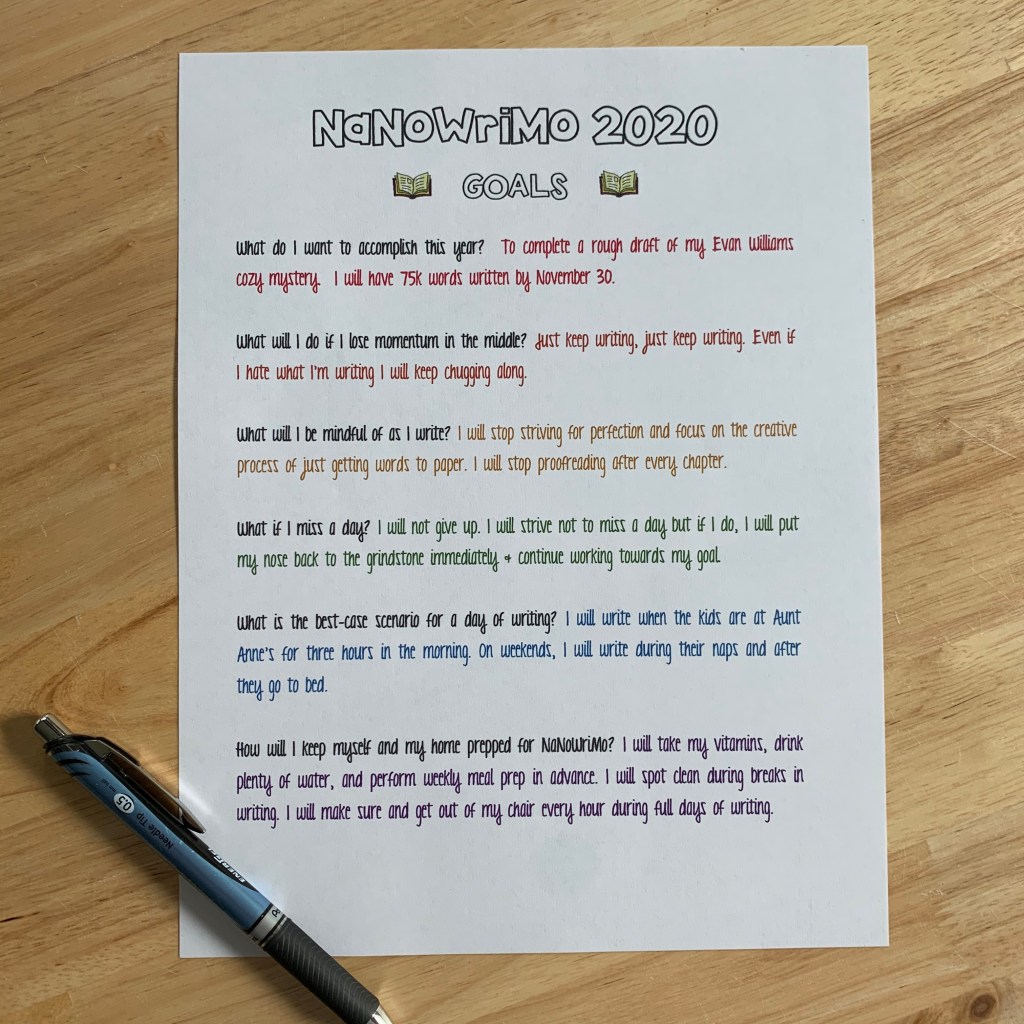
Create a GOAL SHEET – I have a tendency to veer off track of my goal mid-November. My propensity for proofreading as I write slows me down and I lose momentum easily. Having a goal sheet, one situated next to my desk that I can physically look at, allows me to combat some of my known creativity killers.
Break down your word goals into chunks – Look at your calendar for November and take note of any time you know you won’t be able to write. For example, I’m going camping November 20-24. It’s a huge chunk of time where I won’t be in front of my computer. It’s not normal camping where I can sit around a fire and write, either. The hubs and I have a giant four-day event planned where we will be in the woods hitting other nerds with sticks. (I’m a LARPer. Don’t judge.) That being said, I’ve had to set my daily word goal higher so I compensate for those lost days.
Get to know your genre – If you are writing in a brand new genre, take this time to curate a few highly rated novels or short stories in the genre. If you’ve written in this genre before, take a look at some of the recently published reads. What did the author do that excited you about the story? What would you have done differently? Were there any surprises that you wouldn’t have thought of? Did the novel/story keep you from putting it down? If so, what made it so readable? What were shared aspects of every story? How can you incorporate those aspects into your writing?
Get to know your story – If you are rewriting or continuing a WIP, take this time to reread what you currently have. If you are starting from scratch, use this week to imagine the setting of your story. When your characters go about their daily lives, what do they see? What do they smell? Imagine a normal day in the life of your main character from waking until going to sleep. Immerse yourself in your imagination.
Sign up on the NaNoWriMo website if needed or update any information on your current account – Are any of your friends joining you for NaNoWriMo? Add them as buddies to help each other stay accountable.
It’s time to get excited about your writing. Lay the framework down now so when November 1 rolls around, all you have to do is put fingers to keyboard (or pen to paper). Please like my Facebook page to share your adventures in writing and keep track of my progress. I’d love to meet you!
“Give me six hours to chop down a tree and I will spend the first four sharpening the axe.”
Abraham Lincoln
If there’s been any year in our lifespan that has afforded us more opportunity to write, I can’t think of a single one. Holed up in our homes, the availability of alone time has been plentiful and we have a myriad of current events acting as fodder for our creative minds.
On this, the first day of Preptober, I’ve debated with my internal man about finishing a fledgling novel that’s been in the pipeline for years or starting from scratch as I normally do during NaNoWriMo. On one hand, devoting my time to an open project where I will see forward movement is enticing but starting a project at the very beginning is always a challenge I love.
This week, I’ve run the gambit of emotions as I finished up September and readied myself to spend the entirety of October prepping for our 30 days of writing.
As my readers know, I use Scrivener to plan, make notations, create timelines, and ultimately write. The husband and I recently purchased a NAS in order to save our files and last week I began the arduous task of moving every single file over to the new system.
The move was almost complete when I got to my writing folders. My Short Stories transferred flawlessly but when it came time to move my massive Novels file, I received an error message stating the entire folder was corrupted. I could not open a single novel, note, piece of research or submissions spreadsheet. I was mortified to say the least.
Three days, many hours spent on Google trying to fix the problem, and a few pieces of recovery software later, I chalked it up to a loss. This morning, I was staring at the offending file at my computer and thought, “How would I try to fix this if I didn’t have Google?”
I right clicked the file, went to properties, then ran a scan in tools. When Microsoft informed me the file had problems I rolled my eyes and clicked the close box. Another box appeared asking if I wanted the computer to fix the file. With trepidation I clicked yes and immediately, my file was accessible.
Y’all. I beat Google.
My emotions have competed a marathon this week. Photo by Andrea Piacquadio on Pexels.com
All that being said, I now have access to all of my half-finished projects again and I feel like this year should be about bringing something to completion. With all of the tumultuous events that 2020 has brought about, it makes sense that this would be the year I see a NaNoWriMo to the end. Make lemonade out of lemons, I suppose.
I’ll come to the decision tomorrow morning about how to best utilize NaNoWriMo to complete a rough draft. Right now, I have three options:
Start brand new
Continue with my highest word count project (43584 words)
Continue with my most loved project (8385 words)
I’m leaning towards the third choice as I’m very interested to see which direction the story goes and learn more about how to pen a whodunit (It’s a cozy mystery I started last NaNoWriMo.)
Now that my children are one year older, I feel like I have more of a chance to complete the 50k word count goal this time around. A clingy two and four year old really put a damper on my writing last November. I remember telling myself to write after they had gone to bed but to be honest, at the end of the day I was exhausted and fell into dreamland and soon as my head hit the pillow.
I have a roadmap for October’s planning schedule and I’ll expound upon it in more posts as the month tromps on.
My first goal is, as mentioned above, to determine which project I will be working on this year. Tomorrow’s post will bring about that answer and I wait, with baited breath, to see what I will choose.
Feel free to leave a comment here and let me know what you plan on doing for this year’s NaNoWriMo. You can also like my Facebook page to see more insight into my writing life.
Because if it ain’t fun, there’s no use in doing it. Unless it’s crunches.
Below you will find my favorite excerpts from my newest cozy mystery novel drafted during this year’s NaNoWriMo event:
Pearl’s house, if you could call it that, was the picture-perfect embodiment of what would happen if Count Dracula and Sarah Winchester had a baby and it turned out to be a building.
While preparing for NaNoWriMo 2019, I read more books in October than I had all year. I looked at each novel with an Editor’s eye in order to better differentiate what works and what makes a manuscript get shelved before finishing.
The amount of words my brain has trudged through in the past month is vast.
In no particular order, here are the five main story-telling problems I found during my Great Book Devouring Event of 2019:
INFORMATION DUMPING – This was the biggest problem I had and would shelve a book almost immediately if the author cheated and dumped a ton of info on me right away. Let your reader find out backstory via dialogue and short tidbits from time to time. Copious amounts of text explaining what happened in the past is a cop-out. Good writers are better than that.
EXTREMELY DETAILED SETTING AND WORLD BUILDING – Show me the world, don’t tell me about it. A good writer knows that the reader is going to devise their own idea of what the environment looks like in their mind. Don’t try and force your made-up world onto someone else. Share the mood, atmosphere, and locale with your reader and let them create their own landscape. You will draw in a reader much more effectively once they have put some work into the story and created their own stage together in their imagination.
SWITCHING FROM POV TO POV – Some authors can do this properly. Many can’t. If a writer is of the latter group, there is nothing that confuses the reader more than a poorly-strung-together story from various points of view. (I recently picked up a cozy mystery where three different POVs occurred within two paragraphs. It was so confusing, I shelved it after only halfway into the first chapter.)
DIALOGUE THAT SOUNDS FAKE – When editing your novel, read the dialogue aloud. Have friends read the dialogue aloud. Read it aloud again. If the words on paper sound silly when you actually speak them into existence, re-write it.
PLOT THAT DOESN’T MAKE SENSE – It kills me when a main character acts against his/her nature and nothing in the story explains why that choice was made. Also, subplots that trail off and never come to a conclusion are maddening. If you leave your readers open to a “how/what/why?” question once they are done reading your book, you have done them a disservice.
I would love to hear reasons why you shelve books before finishing! Feel free to leave a comment or join my Facebook author page to expound.
I hope this helps as you continue with your novel creation! If you are currently participating in NaNoWriMo, I wish you good luck and ample writing time. ❤️


























 Charlene Singletary